Showing posts with label women empowerment. Show all posts

Wednesday, 20 August 2014

Shield Yourself – So that the Devils Fear to Tread!

December 16th 2012. It was a black letter day for India when a bright and brave girl was violently raped and assaulted in a moving bus by six men. Her body was so brutalised that it shook the entire nation’s conscience. They named her Nirbhaya – the fearless one, given the grit with which she attempted to fight back the brutes as they ripped her gut out with a rusted iron bar. Her parents, from a socially backward community, had rebelled against societal dictat of raising girls as cattle meant only to breed and had gone to great lengths to educate her. Even as the nation seethed with rage and protested, more such assaults followed and it continues to do so. Rampantly. Unabashedly.  

The issues surrounding rape, child abuse and assault that need to be dealt with are many and mired in social, political and legal system failures. However, there is one critical aspect that surprisingly remains overlooked – training of women in self-defence. It isn’t new to India and was in fact an integral aspect in ancient India. During the Maurya Dynasty under Ashoka, as testified in Arthasasthra (~350-283 BC) women were trained in martial arts including sword fighting, bow and arrow, wrestling and were chosen as the bodyguards of kings. The two main Indian martial arts practiced by women in India currently are kushti (wrestling) and kalari (kerala martial art). Kalari was important in the system of education in Kerala where women and men were trained in combat fighting and weaponry fighting. Overall though, training women in self-defence is yet to be taken seriously and even understood correctly.

The Nirbhaya incident sparked the zeal in me to bring to fore this particular aspect since I have always believed in the importance of building physical endurance among women and children. I have worked and activated extensively for causes of child empowerment and fight against child sexual abuse and continue to do so. I was fortunate to be born into a family that encouraged me to pursue sports and training from a young age. It’s also the reason why my preschool is perhaps among the handful in the city for having incorporated a structured sports program which includes martial training for kids as young as three. Generally, self-defence in women has been restricted to a handful from privileged backgrounds. However, what about inclusion of girls from backward communities who face so many challenges daily?

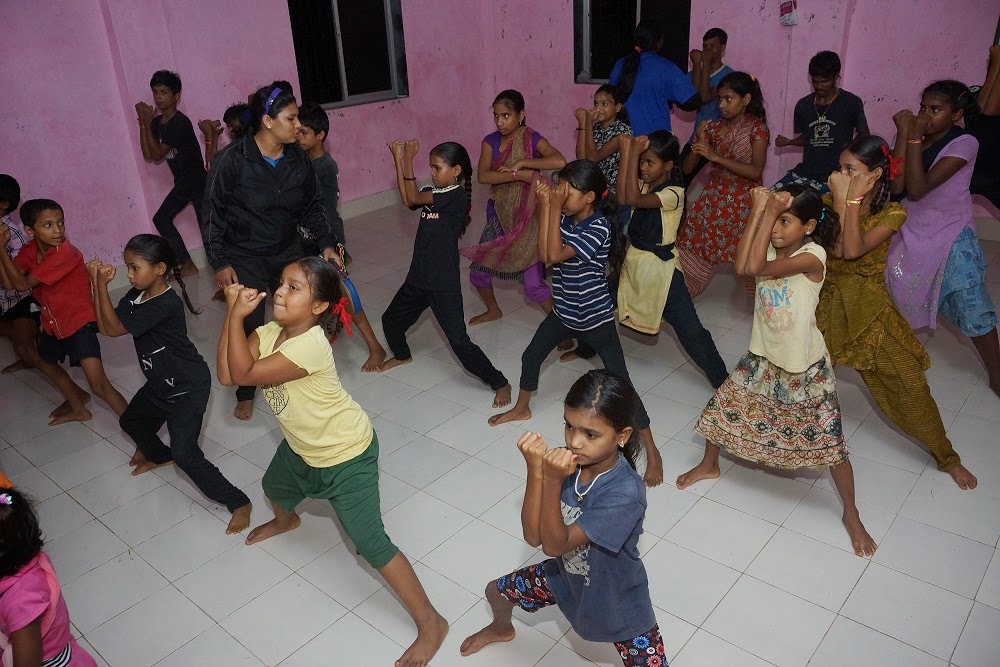
And so, when a group of us got together and reminisced how important it was to launch a martial training initiative for women, as if by collective, intent consciousness ‘Shield Yourself’ concept dawned upon us. First in our hearts then our minds, sparking waves of collective but focussed action and a wondrous mission gathered momentum.  Shield yourself is a martial-training initiative under which girls from 4 years to women of 60 years will be trained to combat  provocative and dangerous assaults. It also aims to sharpen their minds and senses. Our first training centre has been set up in Kandivali East. To commemorate its launch we will be conducting ‘The All Girls Maharashtra Championship’ on 24th August in Mumbai which has 300 martial arts participants from across the state will compete. We have simultaneously begun training 25 girls aged 4-17 years from the tribes that inhabit the Aarey milk colony jungles who are being trained alongside a handful of boys to eliminate any bias for strength training. These girls aspire to take part in championships and participate in state and national events and idolise Mary Kom. Our trainers, expert champions in Kung Fu, have already spotted exceptional talent among quite a few and we are striving to help them realise their dreams.

Kung Fu was conceptualised in ancient India by Gautam Buddha and spread to China where it found an elevated status. It is a combination of Judo and Gymnastics. We focus on animal techniques, kick boxing and have also introduced weapon training. We are also teaching them how common accessories such as pens, waist belt, umbrellas can be used as a weapon. Self-defence training definitely needs a holistic approach and involves going deep into minds of both the victim and the perpetrators of crime. Concurrently, we are also teaching them hygiene and plan to engage with their schools to work upon their standard of education.
I believe self-defence education must be made mandatory in all schools and reports have globally documented the vast benefits of empowering women by imparting these skills. Nirbhaya’s murder represented the killing of millions of aspirations and potential of our girl children, sacrificed for the fear and stigma associated with rape. They are the weaker ones, society says.  Protect Them, Stifle Them, Guard Them but Why not EMPOWER them to fight their battles? It is time we empowered our women to be fearless and invoke fear in the minds of the beasts instead - Shield yourself!


Sunday, 15 June 2014

An Emerging Economy’s ‘Disposable Half’!


The recent Badaun rape case wherein two teenage sisters from lower caste were brutally gang raped and hung from a tree only to have the perpetrators of the crime, high-caste goons, given police solicitation, is telling of the status accorded to the ‘fairer sex’ of the world’s largest democracy. That the girls were from an impoverished, minority caste makes their lives as valuable as the rock we see on the street and infinitely lesser than the rock we worship in our homes and temples. They were among the invisible pariahs, among the 300 million women in India, mostly underprivileged, who defecate in the open, lacking as basic an access to proper sanitation. Hence they had to wait until night fell to protect their modesty only to be preyed upon by gun-wielding brash unemployed ruffians.  The sisters remain another statistic of course; their death, a case to be raked up on media channels, having sufficiently roused the activists, politicians, media anchors and public from a routine slumber. Since then there have reportedly been four such hangings in a spate of two weeks!

In India, violence against women begins even before a girl is born and continues until her death. It is pervasive across domains, its form beyond the depraved sexual assaults. There have been so many such incidents reported of molestations, rapes, acid attacks, bride burning, female infanticides on a daily basis that the public has become largely numb towards it. According to the latest government figures a woman is raped every 20 minutes! The horrific Nirbhaya case attracted much international attention and while Justice Verma Committee did set in some stringent punitive measures, it attempts to tackle one aspect of a multi-dimensional problem. If we were to carefully listen to the conversations that envelop us – in our social circles, within our own and extended communities, our politicians, we realise that the seeds of rape are constantly being sown within the socio-economic and cultural fabric of the country. 

When ministers state that ‘boys will be boys’ and get away with it or question the character of the girl for being out at night or for wearing ‘provocative’ clothing – even as girls as young as one month old to women of eighty years are assaulted and raped. When a mother has to kill her unborn daughter in her womb lest she be burnt alive, when parents keep back daughters from traveling to school lest they get raped, when young girls are forced to marry without having a choice, when daughters are told that they can’t do something that their brothers/ males can, when men are taught to believe that it is ok to hit wives, ignore them and be arrogant. We teach our daughters to be submissive, to retreat, to yield, to endure, to be patient, to choose women oriented careers…Even the educated ones and working ones are taught to hold their tongue, yield in to demands of in-laws, brothers and father, nurture a child almost single handed and keep her needs at the backburner. This is not just the situation of the rural women, even the urban women go through varied degrees of unfreedom. We have six out of seven support female staff members who being married still have a single parent status, struggling to provide for the education of their children and as basic as two square meals a day, while the husbands choose to drink and make merry.  

The discrimination is obvious even within so called urban educated communities. We have often observed it’s often the women (mother-daughter or mother-in-law daughter-in-law) that initially come to check the school for admission. However, while they are convinced and enthusiastic about the infrastructure, curriculum, and ethos of the school, they yet have to go home and convince their husbands and fathers-in-law to permit them to take admission. Hence decision making still is within the male-domain, since it is the men who are the bread winners. Again, we have observed ample instances wherein given a choice between enrolling two children from the same household, decision is made in favour of the boy while the girl is sent to a nearby, relatively ‘cheaper’ school. At a juncture when mindsets are just being formed such discriminatory practices attribute to the imbalance.

It also doesn’t help that with the failure of our education system there are scores of unemployed, uneducated, impoverished youth, mostly men, frustrated, who have been taught to believe that their insecurities can be allayed by yielding power – which can unfortunately be freely sought by belonging to a particular caste or gender or lineage, further empowered by an inefficient judicial or legal system. Power over the gullible is considered a justifiable outlet and an uneducated, unemployed and repressed section makes good victims. To add to it, there is maximum stigma attached to a rape as if the girl has been robbed of everything because she has been sexually exploited. In a way this victimisation encourages rapists since they do so believing it will shame women. Women have anyway been trained to lower their gaze, run for cover and retreat rather than fight, scream, stand for rights or be trained in martial arts. We had undertaken a campaign against child sexual abuse in our school, ‘Chuppi Todo’ (Break the silence) to encourage children from 3 to 15 years to speak up against sexual assault. While some parents appreciated our efforts there were some who were slightly apprehensive. Sex education in India is frowned upon and misconstrued as that which will encourage pre-marital sex, especially in co-ed schools. Issues of menstrual hygiene, critical to maternal and adolescent girls’ health are also hushed and considered a social taboo; according to women’s welfare foundation, Dasra, 88% of the country’s 355 million menstruating women have no access to sanitary pads. Around 66% school girls skip school while having a period and one third of these eventually drop out of school due to lack of toilets and basic hygiene parameters. 

This is where the difference between being a literate as opposed to an educated society becomes starker.  With a desensitised society -- comprising doctors, lawyers, police, politicians, priests, teachers, nurtured by underpowered and illiterate women,  bound by archaic traditions, customs and hypocrisies -- bridging the gender and other social gaps will require tackling from a 360-degree perspective.  Currently, India has the lowest workforce participation rate of women among the BRICS (Brazil, Russia, India, China and South Africa) due to socio-cultural reasons and low education levels. How will a nation progress when such a huge section of its population, which ironically grooms its future, is not empowered? Among the world’s top 20 economies, India is considered the worst in which to be a female, a notch below Saudi Arabia! Enhancing access to schools, improving infrastructure and sanitary conditions, making conditions conducive for women to work by tightening laws, strict and immediate redress of complaints, gender and sex and adult education will go a long way to ensure that women are empowered. Additionally, ensuring that educated citizens are indeed skilled to get jobs, enhancing job-skill match, will ensure that the youth are dispensing their energies constructively and taking the nation forward while taking along with them the marginalised sections of society – rather than them be discovered as unfortunate targets of an imbalanced society, found brutalised and hung from a mango tree like a disposable fraction.