Sunday, 31 August 2014

Empowering Youth – Where Are Our Schools Faltering?

A close friend recently remarked how she has finally made up her mind about dropping out her 13 year old child from a respectable international school and homeschool him. She consulted a large, prominent homeschooling parents group and has now decided to take the plunge.  Schools, she said “were killing my child’s creativity and just providing literacy skills”. She had switched three schools successively and was very unhappy with the quality of education being imparted in schools and its core values. Incidentally, she was already the third parent I knew who would be doing so, joining the ranks of a growing tribe of parents home-schooling their children.  Needless to say, being an educator placing utmost importance on developing of every individual holistically and as true to self, I was perturbed.  Is formal education failing our children?

These were some of the most respectable schools in Mumbai forming the league of new-age international schools, reputed private schools and not public schools or government schools which continues to witness a large exodus of students leaving studies in spite of the RTE Act. (According to reports, in primary school education, the drop-out rate has increased to 0.97% from 0.58% in 2011-12 due to well-established factors like ignorance among parents, responsibilities at home, inaccessibility of schools, disengaging curriculum, migration etc.) Failure of public education system is well documented due to government schools plagued with teacher absenteeism, low teacher morale, crumbling infrastructure and an archaic curriculum which fails to engage students from communities already battling many issues.

However, what about private schools? With the dawn of the new age international schools, low student teacher ratio, holistic development and assessment, great infrastructure, learner-centric modules were introduced. Issues plaguing the traditional education system of rote learning and evaluating students unidimensionally on archaic irrelevant knowledge seemed to have gotten a shot in the arm. However, with thousands of such schools springing up everywhere, lack of effective regulation, dearth of quality teachers, even the better known schools are struggling with learning outcomes. The need for a dynamic system is imperative since education is always in a state of continuity. It is indeed ironical therefore that an institution which has the unparalleled challenge of predicting future needs of a society and moulding the aspirations and skills that will drive it must mould children within set, rigid frameworks.

It isn’t any wonder then that an increasing number of parents and students are getting disenchanted and questioning the method of getting educated. While homeschooling was born due to this gap and has met with much success (though its connotations vary), not many can afford to dedicate the resources in terms of time and money. Do we then have a solution? Renowned academicians and successful personalities have openly questioned the efficacy of mass schooling – an invention of the Industrial Era to train people to work in industries, mould their mindsets and skills from the manual labour they were used to in the Agricultural era. With changing times and the current Information Age, is the current education system run its course? What is education and how must its outcomes be measured?  In this knowledge economy it is undoubtedly the skills of the people that will propel growth of societies and nations.

That we are still grappling with achieving 100% basic literacy in the country is of course a matter of shame. However, what is equally perturbing is that even our graduates and postgraduates from well-reputed colleges are finding it difficult to get employed.  A recent study highlighted that while India has among the highest number of engineers graduating, a meagre 10% was found to be employable. Which means the education of 90% engineers isn’t worth a dime! And this is the scenario of typically every professional and graduate degree course. Clearly, we need to evolve fast! Merely paying lip service to education –as defined eons ago -- isn’t going to take us further.
We need to rehaul the entire education system which would truly empower every child irrespective of socio-economic background to reach his/her potential. Schools must be lively, dynamic, interactive bodies perpetuating creativity and not stifling it. We need to encourage children to learn at their own pace, do away with age criteria to write board exams, focus on imparting skills-based education and change assessment patterns which only tests linguistic and literacy prowess of children. We need to interweave the systematic study of the arts especially fine arts and performing arts.

A child is constantly learning – from his environment, school, parents, friends, nature… Why then seek education within the four walls of a classroom alone? Learning should be fun. According to the US Census Bureau by 2025 India is set to surpass China as the largest country with largest proportion in the working age category. This demographic dividend is expected to add 2 percentage points per annum to India’s per capita GDP growth. Can we imagine the contribution of an empowered youth comprising thinkers, innovators, entrepreneurs, artists, activists, writers, skilled force in the coming years? This requires a drastic change in the mind-sets of all stakeholders. We need to work as partners – the parents, the school and the state.  It was a wise person who said ‘It takes a village to raise a child.’


Wednesday, 20 August 2014

Shield Yourself – So that the Devils Fear to Tread!

December 16th 2012. It was a black letter day for India when a bright and brave girl was violently raped and assaulted in a moving bus by six men. Her body was so brutalised that it shook the entire nation’s conscience. They named her Nirbhaya – the fearless one, given the grit with which she attempted to fight back the brutes as they ripped her gut out with a rusted iron bar. Her parents, from a socially backward community, had rebelled against societal dictat of raising girls as cattle meant only to breed and had gone to great lengths to educate her. Even as the nation seethed with rage and protested, more such assaults followed and it continues to do so. Rampantly. Unabashedly.  

The issues surrounding rape, child abuse and assault that need to be dealt with are many and mired in social, political and legal system failures. However, there is one critical aspect that surprisingly remains overlooked – training of women in self-defence. It isn’t new to India and was in fact an integral aspect in ancient India. During the Maurya Dynasty under Ashoka, as testified in Arthasasthra (~350-283 BC) women were trained in martial arts including sword fighting, bow and arrow, wrestling and were chosen as the bodyguards of kings. The two main Indian martial arts practiced by women in India currently are kushti (wrestling) and kalari (kerala martial art). Kalari was important in the system of education in Kerala where women and men were trained in combat fighting and weaponry fighting. Overall though, training women in self-defence is yet to be taken seriously and even understood correctly.

The Nirbhaya incident sparked the zeal in me to bring to fore this particular aspect since I have always believed in the importance of building physical endurance among women and children. I have worked and activated extensively for causes of child empowerment and fight against child sexual abuse and continue to do so. I was fortunate to be born into a family that encouraged me to pursue sports and training from a young age. It’s also the reason why my preschool is perhaps among the handful in the city for having incorporated a structured sports program which includes martial training for kids as young as three. Generally, self-defence in women has been restricted to a handful from privileged backgrounds. However, what about inclusion of girls from backward communities who face so many challenges daily?

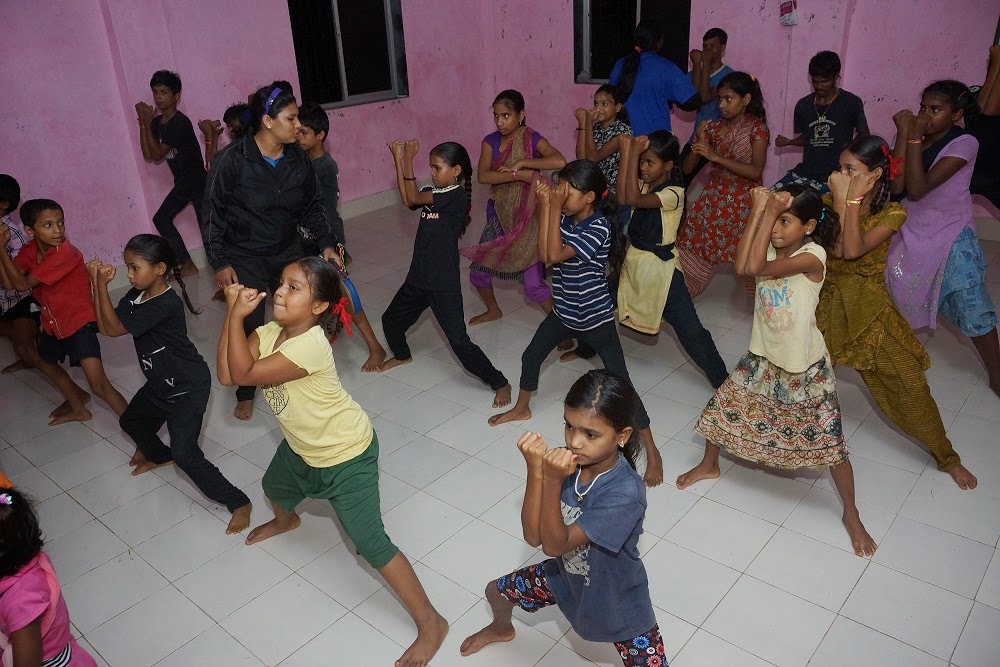
And so, when a group of us got together and reminisced how important it was to launch a martial training initiative for women, as if by collective, intent consciousness ‘Shield Yourself’ concept dawned upon us. First in our hearts then our minds, sparking waves of collective but focussed action and a wondrous mission gathered momentum.  Shield yourself is a martial-training initiative under which girls from 4 years to women of 60 years will be trained to combat  provocative and dangerous assaults. It also aims to sharpen their minds and senses. Our first training centre has been set up in Kandivali East. To commemorate its launch we will be conducting ‘The All Girls Maharashtra Championship’ on 24th August in Mumbai which has 300 martial arts participants from across the state will compete. We have simultaneously begun training 25 girls aged 4-17 years from the tribes that inhabit the Aarey milk colony jungles who are being trained alongside a handful of boys to eliminate any bias for strength training. These girls aspire to take part in championships and participate in state and national events and idolise Mary Kom. Our trainers, expert champions in Kung Fu, have already spotted exceptional talent among quite a few and we are striving to help them realise their dreams.

Kung Fu was conceptualised in ancient India by Gautam Buddha and spread to China where it found an elevated status. It is a combination of Judo and Gymnastics. We focus on animal techniques, kick boxing and have also introduced weapon training. We are also teaching them how common accessories such as pens, waist belt, umbrellas can be used as a weapon. Self-defence training definitely needs a holistic approach and involves going deep into minds of both the victim and the perpetrators of crime. Concurrently, we are also teaching them hygiene and plan to engage with their schools to work upon their standard of education.
I believe self-defence education must be made mandatory in all schools and reports have globally documented the vast benefits of empowering women by imparting these skills. Nirbhaya’s murder represented the killing of millions of aspirations and potential of our girl children, sacrificed for the fear and stigma associated with rape. They are the weaker ones, society says.  Protect Them, Stifle Them, Guard Them but Why not EMPOWER them to fight their battles? It is time we empowered our women to be fearless and invoke fear in the minds of the beasts instead - Shield yourself!


Monday, 28 July 2014

Child Abuse - Thriving at the wrong end of the stick!

The recent rape of a six-year-old schoolgirl in a reputed Bangalore school jolted the nation’s conscience. Even as a national outrage ensued, several shocking incidents of child abuse were reported across the country. Crimes against children are indeed reaching alarming proportions. The National Crime Records Bureau reported a total of 58,224 crimes against children, up 52 percent from last year and a whopping rise by 133 percent over 2009! And these are just what have been reported. A government report in 2007 highlighted 53 percent children have faced one or more forms of sexual abuse. It is a fact that most cases go unreported for the fear of social stigma, an inept bureaucracy and judicial system.

The Bangalore incident is outrageous more so since a child was abused within the vicinity which was supposed to protect and nurture her!  The management’s callous and unscrupulous approach of allegedly covering up the crime and destroying evidence is despicable. It highlights the need for parents to understand the core values of the school vis-à-vis the projected glamour in its sales pitch or brochures. It also emphasises the pertinent need for doing a thorough background and criminal record check when inducting school faculty and for providing regular counselling to school staff. 

Technically, it 's a wake-up call to schools all over the country particularly the government since most government schools are without functional toilets, boundary walls and any basic security! According to a 2012 survey by a children’s foundation, only 10 per cent schools had a child protection policy. Even though the Protection of Children from Sexual Offences (POSCO) Act came into effect in 2012, a meagre number of schools have complied.

While child abuse is yet another eventuality of lack of stringent punitive measures, a crippled social/economic environment and an apathetic bureaucracy, one of the most inadvertent causes is the society itself. It stems from the recesses of a society’s darkest alleys and personnel from schools as other professionals are of course an extension of it. Could WE have a role in the thriving of this evil? Let’s reflect. How do we treat a child? How seriously do we listen to a little voice? Do we encourage children to speak up? 

Even in education, far too much emphasis has been given to respect teachers rather than respect oneself first; on being obedient rather than take initiatives or lead or learning to state differences of opinion; on inducing discipline at all costs! Are we treating our children with the respect they deserve so they know the difference when they are being treated otherwise and are confident to oppose it? Spine-chilling visuals of a three-year-old being brutally beaten and kicked around by his tutor and that of a visually impaired child being beaten by his teachers speak of a deeply embedded issue.

The issue highlights a critical miss of the Indian society which believes that discipline and corporal punishment go hand-in-hand. How can respect be derived from children when it is withdrawn from them?  What good does locking a child in a dark room serve? A school’s perspective when it comes to protecting or disciplining a child speaks volumes of its commitment to preserve and respect the sanctity of a child’s being. 

Positive disciplinary techniques can be used to assist children acquire correct behaviour without the fear of violence. However, most teachers aren’t equipped or are too understaffed to handle so many kids. Patience wears thin; unsurprisingly, the very first casualty is the confidence of the child! Unfortunately, abusers prey on such timid and battered spirits.        

A floundered parent community in Bangalore was quoted describing the sports instructor who raped the six-year old - “He looked normal”, “He is married”, “His wife is pregnant”, etc. These are stereotypical assumptions we keep encountering in our campaign against child abuse which we initiated years back. Child abuse rattles us and we can’t believe that humans can assuage the role of monsters with such ease but the fact is that there is no ‘type’ or an abuser profile. For certainty though, they thrive on silence. A child’s!

‘Chuppi todo’ or ‘Break the silence’ is a crucial activity we undertake by sensitising children, as young as two years, to ‘good and bad touch’. But undoubtedly, the most important aspect is the trust a child shares with the parent which enables her to be herself, stand for her beliefs, speak up loudly and be confident she will be listened to. ‘Disciplining’ shouldn’t be at the cost of breaking that sacred bond. 

Every child is worthy of our absolute attention. The most important belief we must embed in our young through our interaction with them at home and school is best summed by the tagline of a popular commercial - ‘I am worth it!’

Sunday, 29 June 2014

How are we measuring the worth of our youth?


Stereotypical stories about achieving success captivate and abound us. A fallen hero who rises against all odds, an underdog winning a race, a college dropout founding a multi-billion dollar IT company, the rise of a leader from among underprivileged masses, so on and so forth. We find ourselves rooting for the protagonist, empathizing with his/her inner fears that surface in their quest. Such stories hook us for two key reasons - 1. The hope that even the ordinary – regardless of social/economic standing, physical attributes, academic background, character flaws etc. eventually find ‘success’ as they dream it and 2. Perhaps, more importantly, the reinforcement that success is implicit and a necessity to be vindicated. Who likes to hear about failures? Success sells.  

The board-result mania that gripped us this month with tutorials displaying advertorials and colossal hoardings of ‘toppers’, more prominent than that of key personalities or causes in the country, is indicative of how importantly society views academic success. What is ironical is that though everyone seeks success for themselves or others (children, spouse, sibling), the overriding belief is that there is a uniform formula to achieve it. It begins young. A student is tutored, made to memorise facts regardless if it translates to relevant knowledge. Every student is assumed to be a replica of the next – trained, evaluated and classified uniformly. Our education system has yet to reinvent itself - develop challenging, diverse modules for engaging various aptitudes and invent accurate assessment structures to aid in forming and gauging true potential across fields.  

It isn’t as if ‘topping’ an exam is a fool-proof indicative of potential or genius.  At most, it has attributed to a rat race with students pressured to perfect scores right up to 100th percentile. This year, in Delhi, the number of CBSE grade 12 students scoring above 95% marks over last year jumped by nearly 3,000 students or by 50 per cent! Reportedly, the Delhi University received over 3 lac admissions in just a couple of days and apparently lacs of students who have scored above 90% may not get admissions anywhere. The city was also home to the ‘all-India topper’ scoring the highest-ever percentage score of 99.6! Education institutions have become hubs of breeding ‘toppers’ with staggering ‘cut-offs’ hence only admitting the best. Some schools even hold back students that are weaker in academics for the fear of compromising an elite pass-out rate.

With such reinforcements is it a wonder that most of us perceive success as an outcome and rarely as a continuous process?  Success is about winning a competition, a race, scoring top marks, setting records - assessing our worth.  Failure is dreaded upon and any such risks eliminated by following a tested formula. Although the basic tenet is that success follows when pursuing doggedly what one believes in! All that has come of such a system are millions of failed or stifled aspirations. There are far too many stories of doctors and engineers becoming successful after pursuing their life-long dream – as writers or artists, sportsmen, politicians, businessmen etc. While stories of ‘toppers’ are celebrated annually, there is a casualty – parallel stories of suicides among students touching alarming proportions.

In my tenure as a Principal of one of the foremost and respectable international schools, I have had students confide how parents don’t understand them. Students are made to feel guilty of been given the ‘best opportunities’ and goaded to achieve the dreams that their parents see for them. I have also been privy to the guilt and helplessness that some parents feel when their bright or talented children are made to sacrifice their dreams and settle for ‘safer’, unchallenging, ‘prestigious’ vocations, since society believes that certain occupations are best left to a particular gender or the rich (who can afford to experiment). To develop a lifelong love for learning is a key outcome a purposeful education system must strive for. Yet, we are stuck with archaic systems - conforming skills of a majority into a stereotypical mould; dreams killed in the process. And we wonder why true success eludes us.  Most of us nurture our dreams only in our minds, fearing ‘failure’. It explains our fondness for stories celebrating ‘success’ – ironically, it can hardly afford to be elusive in ‘reel’ life!   


Sunday, 15 June 2014

An Emerging Economy’s ‘Disposable Half’!


The recent Badaun rape case wherein two teenage sisters from lower caste were brutally gang raped and hung from a tree only to have the perpetrators of the crime, high-caste goons, given police solicitation, is telling of the status accorded to the ‘fairer sex’ of the world’s largest democracy. That the girls were from an impoverished, minority caste makes their lives as valuable as the rock we see on the street and infinitely lesser than the rock we worship in our homes and temples. They were among the invisible pariahs, among the 300 million women in India, mostly underprivileged, who defecate in the open, lacking as basic an access to proper sanitation. Hence they had to wait until night fell to protect their modesty only to be preyed upon by gun-wielding brash unemployed ruffians.  The sisters remain another statistic of course; their death, a case to be raked up on media channels, having sufficiently roused the activists, politicians, media anchors and public from a routine slumber. Since then there have reportedly been four such hangings in a spate of two weeks!

In India, violence against women begins even before a girl is born and continues until her death. It is pervasive across domains, its form beyond the depraved sexual assaults. There have been so many such incidents reported of molestations, rapes, acid attacks, bride burning, female infanticides on a daily basis that the public has become largely numb towards it. According to the latest government figures a woman is raped every 20 minutes! The horrific Nirbhaya case attracted much international attention and while Justice Verma Committee did set in some stringent punitive measures, it attempts to tackle one aspect of a multi-dimensional problem. If we were to carefully listen to the conversations that envelop us – in our social circles, within our own and extended communities, our politicians, we realise that the seeds of rape are constantly being sown within the socio-economic and cultural fabric of the country. 

When ministers state that ‘boys will be boys’ and get away with it or question the character of the girl for being out at night or for wearing ‘provocative’ clothing – even as girls as young as one month old to women of eighty years are assaulted and raped. When a mother has to kill her unborn daughter in her womb lest she be burnt alive, when parents keep back daughters from traveling to school lest they get raped, when young girls are forced to marry without having a choice, when daughters are told that they can’t do something that their brothers/ males can, when men are taught to believe that it is ok to hit wives, ignore them and be arrogant. We teach our daughters to be submissive, to retreat, to yield, to endure, to be patient, to choose women oriented careers…Even the educated ones and working ones are taught to hold their tongue, yield in to demands of in-laws, brothers and father, nurture a child almost single handed and keep her needs at the backburner. This is not just the situation of the rural women, even the urban women go through varied degrees of unfreedom. We have six out of seven support female staff members who being married still have a single parent status, struggling to provide for the education of their children and as basic as two square meals a day, while the husbands choose to drink and make merry.  

The discrimination is obvious even within so called urban educated communities. We have often observed it’s often the women (mother-daughter or mother-in-law daughter-in-law) that initially come to check the school for admission. However, while they are convinced and enthusiastic about the infrastructure, curriculum, and ethos of the school, they yet have to go home and convince their husbands and fathers-in-law to permit them to take admission. Hence decision making still is within the male-domain, since it is the men who are the bread winners. Again, we have observed ample instances wherein given a choice between enrolling two children from the same household, decision is made in favour of the boy while the girl is sent to a nearby, relatively ‘cheaper’ school. At a juncture when mindsets are just being formed such discriminatory practices attribute to the imbalance.

It also doesn’t help that with the failure of our education system there are scores of unemployed, uneducated, impoverished youth, mostly men, frustrated, who have been taught to believe that their insecurities can be allayed by yielding power – which can unfortunately be freely sought by belonging to a particular caste or gender or lineage, further empowered by an inefficient judicial or legal system. Power over the gullible is considered a justifiable outlet and an uneducated, unemployed and repressed section makes good victims. To add to it, there is maximum stigma attached to a rape as if the girl has been robbed of everything because she has been sexually exploited. In a way this victimisation encourages rapists since they do so believing it will shame women. Women have anyway been trained to lower their gaze, run for cover and retreat rather than fight, scream, stand for rights or be trained in martial arts. We had undertaken a campaign against child sexual abuse in our school, ‘Chuppi Todo’ (Break the silence) to encourage children from 3 to 15 years to speak up against sexual assault. While some parents appreciated our efforts there were some who were slightly apprehensive. Sex education in India is frowned upon and misconstrued as that which will encourage pre-marital sex, especially in co-ed schools. Issues of menstrual hygiene, critical to maternal and adolescent girls’ health are also hushed and considered a social taboo; according to women’s welfare foundation, Dasra, 88% of the country’s 355 million menstruating women have no access to sanitary pads. Around 66% school girls skip school while having a period and one third of these eventually drop out of school due to lack of toilets and basic hygiene parameters. 

This is where the difference between being a literate as opposed to an educated society becomes starker.  With a desensitised society -- comprising doctors, lawyers, police, politicians, priests, teachers, nurtured by underpowered and illiterate women,  bound by archaic traditions, customs and hypocrisies -- bridging the gender and other social gaps will require tackling from a 360-degree perspective.  Currently, India has the lowest workforce participation rate of women among the BRICS (Brazil, Russia, India, China and South Africa) due to socio-cultural reasons and low education levels. How will a nation progress when such a huge section of its population, which ironically grooms its future, is not empowered? Among the world’s top 20 economies, India is considered the worst in which to be a female, a notch below Saudi Arabia! Enhancing access to schools, improving infrastructure and sanitary conditions, making conditions conducive for women to work by tightening laws, strict and immediate redress of complaints, gender and sex and adult education will go a long way to ensure that women are empowered. Additionally, ensuring that educated citizens are indeed skilled to get jobs, enhancing job-skill match, will ensure that the youth are dispensing their energies constructively and taking the nation forward while taking along with them the marginalised sections of society – rather than them be discovered as unfortunate targets of an imbalanced society, found brutalised and hung from a mango tree like a disposable fraction.